


Project overview
The Career Pathways for Racialized Newcomer Women (CPRNW) pilot project was an exciting innovative multiyear pilot project designed to better support racialized newcomer women in entering the Canadian labour market. This page describes the project’s context, CPRNW models and core features, the rationale behind those features, its network of partners, and how the pilot was evaluated.
The Career Pathways for Racialized Newcomer Women (CPRNW) pilot project was a pan-Canadian research project that tested 12 employment services interventions for racialized newcomer women which were implemented by eight service partners. The goal of the research project was to test four models of employment services to learn what works to support racialized newcomer women in finding good quality employment.
The Social Research and Demonstration Corporation (SRDC) received funding from Immigration, Refugees and Citizenship Canada (IRCC) to design, implement, and evaluate the pilot. The pilot project was delivered by eight service provider organizations across Canada implementing 12 interventions based on four models: ACCES Employment (GTA), Achēv (GTA), Immigrant Services Association of Nova Scotia (Halifax), MOSAIC (Vancouver), Opportunities for Employment (Winnipeg), la Société économique de l’Ontario (Ottawa, Sudbury, Toronto), World Skills Employment Centre (Ottawa), and the YWCA (Metro Vancouver).
The insights and evidence generated through the pilot project were internalized by the service partners during its implementation as they adapted programming to better serve their CPRNW clients. Service partners also incorporated the pilot’s lessons into their other programming and, for some, into new initiatives. The pilot findings and lessons learned are expected to continue informing effective strategies that improve employment outcomes for racialized newcomer women.
On average, the labour market outcomes of racialized newcomer women in Canada are lower than Canadian-born women, particularly in the initial months and years after arriving in Canada1 . There are many potential explanations which are linked to the intersecting identities of being a newcomer, a woman, and a member of a racialized or visible minority group.
Job search assistance programs have proven effective in improving employment outcomes for newcomer job seekers2. In Canada, a wide range of such programs exists, varying in duration from a few hours to several months. These programs typically offer services such as resume writing, interview preparation, language and skills training, career counselling, and employer connections. However, prior to the CPRNW pilot, we are not aware of any government-funded employment programs specifically designed to support racialized newcomer women by addressing the unique and intersecting barriers they face in the Canadian labour market.
In 2018–19, the Government of Canada announced a $31.9 million investment to support racialized newcomer women in securing employment. As part of this initiative, the Career Pathways for Racialized Newcomer Women pilot—originally launched as a three-year national project and later extended to 2022–23—was introduced to test employment programming tailored to the needs of racialized newcomer women. The Social Research and Demonstration Corporation (SRDC) received funding from Immigration, Refugees and Citizenship Canada (IRCC) to design, implement, and evaluate the CPRNW pilot.
Newcomer women represent a growing segment of Canadian society. Based on the 2021 Census3 , almost a quarter of Canadian women (23.8%) were immigrants. A significant proportion of these women identified as a visible minority: seven out of ten immigrant women (69.8%) and 83.8% of recent female immigrants identified as a visible minority. In this project, we use the term racialized to refer to newcomer women who identify as visible minorities.
Most newcomer women tend to be highly educated- in 2021, 47.7%4 held a university degree or higher5 and were primarily admitted to Canada under the economic class (53.3%), followed by the family class (29.6%), and refugees (15.4%)6.
Newcomers arrive from a wide range of countries7, and Canada’s racialized population includes individuals from diverse groups such as South Asian, Chinese, Black, Filipino, Latin American, Arab, Southeast Asian, West Asian, Korean, and Japanese backgrounds8.
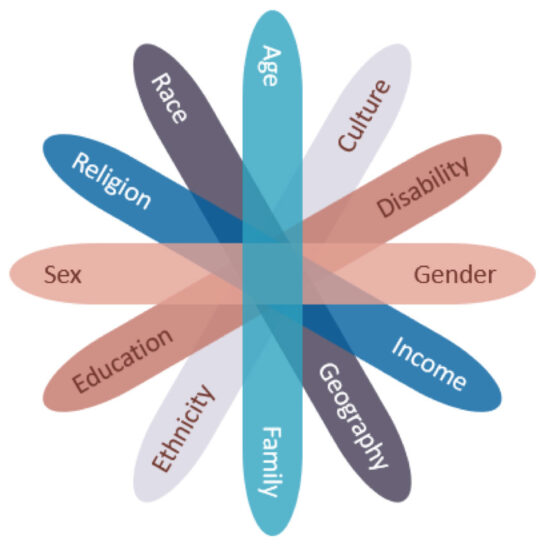
Beyond ethnicity, racialized newcomer women are a highly diverse group. Each woman brings a unique set of experiences and identities, shaped by factors such as age, education, language, family roles, and migration history. Each of these factors — several are presented in Figure 1 — affects individual experiences. These intersecting identities influence how each woman navigates the labour market, the barriers she may encounter, and how she experiences those challenges. Figure 1 illustrates several of these intersecting factors that shape the diverse experiences of racialized newcomer women in Canada.
[1] The term “visible minority” is used in the Employment Equity Act to define one of four designated groups. The aim of the Act is to achieve workplace equality and to correct employment disadvantages for the four groups. Visible minority persons are identified according to the Employment Equity Act as being non-Caucasian in race or non-white in colour.
[2] Recent immigrants (also known as newcomers or recent arrivals) are landed immigrants who came to Canada up to five years prior to a given survey year or census year.
Canada has one of the highest per capita inflows of newcomers globally, and immigration is projected to remain a key driver of the country’s demographic and labour force growth9. In fact, over the next decade, newcomers are expected to account for the entire net increase in the labour force and population growth10. Despite this, many immigrants—particularly women who identify as visible minorities—face significant challenges entering the labour market11.
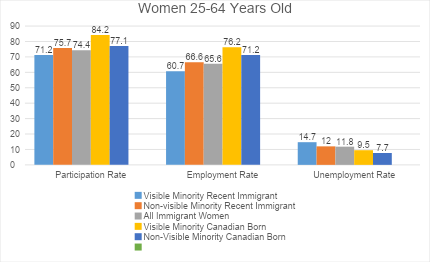
Labour market data highlight these disparities. Among women aged 25 to 64, recent immigrant women who identify as visible minority have a labour force participation rate of 71.2%, compared to 77.1% for non-visible minority Canadian-born women12. Employment rates also differ sharply: 60.7% for visible minority recent immigrant women versus 71.2% for their Canadian-born counterparts13. Figure 2 illustrates these and other labour market indicators by immigration and visible minority status, showing that recent racialized newcomer women have the lowest participation and employment rates, and the highest unemployment rate among the four groups of women represented.
 .
.
In addition to lower participation and employment rates, income disparities are also well documented. Employed racialized immigrant women earn significantly less than Canadian-born non-racialized women, with a median annual employment income gap of $8,400. 14
There is broad consensus in the settlement literature that economic integration is a critical step in the broader social and cultural integration of newcomers. For many, transitioning into meaningful employment or re-entering their profession is one of the most challenging aspects of the settlement process.
For racialized newcomer women, this transition is particularly complex due to the intersection of multiple identity factors and systemic barriers. These include:
- Barriers commonly faced by newcomers: Racialized newcomer women often face challenges shared by many immigrants, such as limited pre-arrival knowledge of the Canadian labour market, non-recognition of foreign credentials, insufficient language proficiency, lack of Canadian work experience, and the undervaluing of international work experience. Additional barriers include unfamiliarity with Canadian workplace culture, limited social networks, and employer reluctance to hire newcomers. These challenges are well documented in the literature15.
- Intersecting discrimination: These women may experience compounded discrimination based on their race, gender, and newcomer status, which can further hinder their access to employment opportunities.
- Gendered responsibilities and cultural expectations: As primary caregivers in many families, newcomer women often face additional barriers such as the lack of affordable childcare, limited support networks, and cultural gender norms that may restrict their ability to participate in the labour market.
The CPRNW pilot project tested four program models to better support racialized newcomer women in entering the Canadian labour market. The models were developed after a thorough analysis of findings from a previous literature review, environmental scan, discussions with racialized newcomer women and 11 consultations with immigrant serving organizations, women’s associations, employment service providers, employer councils and other key stakeholders across Canada.
The overall goal of each model was to support racialized newcomer women in their successful integration in the Canadian labour market. The models differed by their target population (e.g., women with different initial distances from the labour market and different labour market barriers) as well as by the program activities involved. The models aimed to address some of the common barriers racialized newcomer women face in their search for employment and in job retention and were designed with a Gender-based Analysis (GBA) Plus lens. The GBA Plus lens ensured that, in the design of the models, consideration was given to the multiple identity factors of potential participants and how those factors may intersect and affect someone’s experience of the program and its results.
Figure 2 illustrates the continuum of the target populations’ distances from the labour market and where each model falls along it.
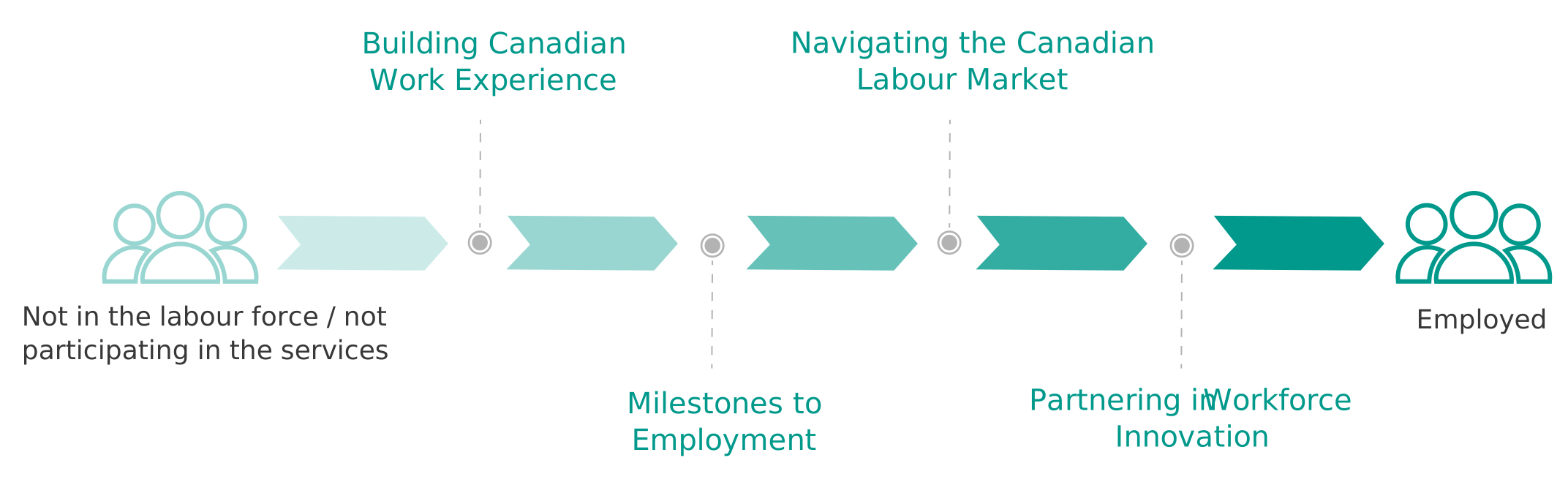
The main aspects of each model are summarized below.
Model A: Partnering in Workforce Innovation
This is a demand-driven approach that uses recruitment specialists working directly with employers/sectors with significant workforce needs to match them with women who have the job-related skills, career interest, and abilities to perform the job.

Target population:
Newcomer women who identify as racialized and who are ready to be employed, regardless of their education level, as their required competencies and education level will depend on the nature of the available jobs.
Key components:
- Needs assessment of employers and participants
- Employment readiness workshops or training (if needed)
- Job matching
- Ongoing individualized support
Approximate program duration:
- Société économique de l’Ontario (SÉO): Individualized support
- World Skills Employment Centre (WSEC): 8-day training + continued support
Model B: Navigating the Canadian Labour Market
This model offers support in the development of a clear career plan based on a thorough assessment of participants’ skills and provides them with opportunities to connect with potential employers. This model applies the Essential Skills (now the Skills for Success) framework developed by the Government of Canada.16

Target population:
Newcomer women who identify as racialized and are ready or almost ready to work in Canada (i.e., women with post-secondary education and an adequate level of fluency in English or French).
Key components:
- Employment readiness training, including the development of a skills portfolio based on intended occupation
- Essential Skills enhancements (if needed as determined by skills assessments)
- Employer connections
Approximate program duration:
- ACCES: 5-week training + 10-week skills enhancement, if needed
- Achēv: 2-week training + 10-week skills enhancement, if needed
- Immigrant Services Association of Nova Scotia (ISANS): 6-week training + 10-week skills enhancement, if needed
- WSEC: 35-hour training + continued support
- YWCA Metro Vancouver: 3-week training + 10-week skills enhancement, if needed
Model C: Milestones to Employment
This model takes a demand-led approach to support racialized newcomer women in finding employment in high-demand industries and sectors. The model provides participants with learning pathways to gaining employment with a large employer or in a sector based on the completion of multiple intermediate steps, or milestones, leading to the desired employment outcomes. The program aims to facilitate and support the transition to a work placement, with the ultimate goal of continued employment and advancement. By aligning training with newcomer women’s needs while also preparing them to meet the needs of employers in specific sectors, the program ensures that work placements are beneficial for both employers and job seekers.

Target population:
Newcomer women who identify as racialized who do not have multiple barriers that would prevent them from participating in employment services, but who are otherwise relatively distant from the labour market (e.g., those with little or no Canadian work experience, individuals with lower education credentials or skills, or working in precarious, part-time or “survival” jobs).
Key components:
- Employer engagement, including needs assessment
- Employment readiness training (if needed)
- Occupation-specific training
- A work placement or a work experience
- Ongoing individualized support to both newcomer women and employers
Approximate program duration:
- Achēv: 4-week training + 12-week work placement
- MOSAIC: 4-week training + 12-week work placement
- OFE: Individual-specific
Model D: Building Canadian Work Experience
This model is designed to create paid short-term employment to assist unemployed racialized newcomer refugee women in gaining meaningful Canadian work experience. It aims to enhance participants’ employability readiness, skills, workplace culture knowledge, and networks by providing a Canadian work experience opportunity.

Target population:
Newcomer racialized refugee women receiving social assistance and who are distant from the labour market.
Key components:
- Employment readiness training
- A paid work placement (through a 75% wage subsidy to employers)
- Ongoing individualized support
Approximate program duration:
- YWCA: 6-week training + 12-week work placement
- ISANS: 4-week training + 12-week work placement
The evaluation of the pilot used a mixed methods approach and was guided by a GBA Plus lens, ensuring that diversity and inclusion were part of the evaluation process. The GBA Plus analysis investigated how the multiple identity factors of potential participants intersect and affect someone’s experience of and results from programming.
Due to differences in intervention design and implementation across the pilot service partners, their target populations, and local labour market conditions, the evaluation was conducted at three inter-related levels: the intervention level, the model level, and the overall project level. The quantitative analysis was conducted at the intervention level and at the model level (where appropriate) while most of the qualitative analysis was conducted at the model level. The quantitative and qualitative findings were then consolidated to inform the overall project level findings.
The Career Pathways for Racialized Newcomer Women (CPRNW) pilot was not designed to identify the impacts of specific program activities. CPRNW interventions provided a holistic approach to programming. Each activity, such as resume writing or job matching, was not developed or implemented in isolation. As such, results cannot be attributed to a specific activity because they depend on the other program activities received. Moreover, comparisons across models should always consider that the models targeted and provided services to women at different initial distances from the labour market and with different characteristics and barriers to labour market integration. They were also implemented in different localities with different economic conditions.

